Whether you are a frequent trader or not, investors will inevitably come across this situation: Being “stuck” with an investment because swapping it for another would cost a lot of taxes. Most times this results in indecision, and a less-than-ideal portfolio. This article will walk through the analysis behind how an investor might think it through using expense ratios and projected performance statistics.
A popular US Small stock mutual fund with a high expense ratio, was purchased in 2020 and is sitting at a 57% gain. Another similar fund with a much lower cost is identified as a better replacement. But because the old stock grew substantially, selling it would cost you $13,478 in taxes.

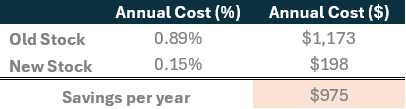
This sounds like a bad idea just to save some expense, and it would be considering only the expenses of each fund. It would take close to 14 years to recoup the tax bill.
Another variable to consider would be performance. If you knew which fund would give you a higher return, then the decision would be easy. Most know that is impossible to forecast. However, if you are considering selling a mutual fund in favor of an index tracking exchange traded fund (ETF), statistics show that might be a good bet. According to S&P Global, 87.42% of large-cap mutual funds underperformed the benchmark S&P500 Index over the last 10 years [1].
What would that look like? And how is this related to the tax bill? Compared below are the two small cap funds from above, an ETF and mutual fund. In this case the ETF performed better over the long-term, and the tax bill could be thought of as “paid off” after 3-4 years.
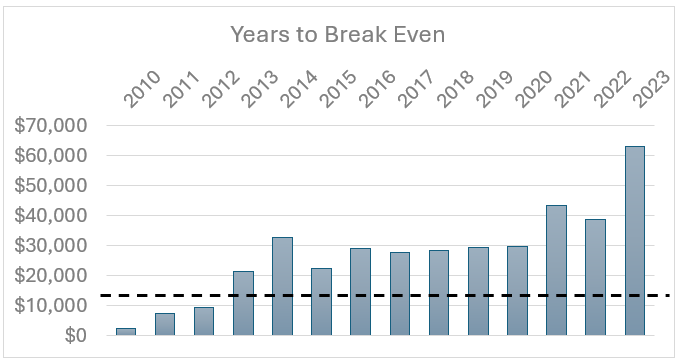
This is just one example showing the thought process of getting beyond indecision using the data available to you. Before switching from one investment to another, make sure expense ratios are addressed, but also projected performance. Some funds could be worth their costs, while others fail to consistently beat their ETF counterparts.
[1] https://www.spglobal.com/spdji/en/research-insights/spiva/
Disclosure
All calculations within are performed from scratch and, while diligent efforts are made to ensure accuracy, may contain unaudited errors. The content provided is for informational purposes only and should not be construed as investment advice, an offer, or a solicitation to buy or sell any financial instruments. Readers should consult with a qualified financial advisor for personalized advice tailored to their individual circumstances. All investments are subject to a risk of loss. Diversification and strategic asset allocation do not assure profit or protect against loss in declining markets. These materials do not take into consideration your personal circumstances, financial or otherwise.
 Wealth Studio
Leave a comment