Risk Tolerance – Your willingness to take risk in the investment markets. Based on how you feel.
Risk Capacity – A measurement of how aggressive you can invest without jeopardizing financial stability. Based on math and statistics.
Often times an investors portfolio mix is said to be determined by a questionnaire that tells you your “risk tolerance”. If you have a high tolerance, it spits out a result telling you to invest heavily in stock. Is this right? Maybe. At best its only half of the equation. This article looks at the importance of risk capacity in addition to tolerance. Both factors should be used to determine your appropriate investment portfolio mix (stock, bonds, etc).
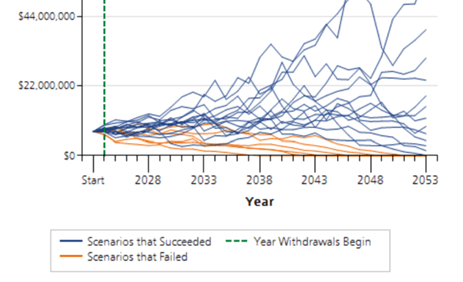
Here’s a simple example: you are a risky investor with a very high risk tolerance. Unbeknownst to you, your portfolio could not support your lifestyle if the stock market crashed (it has a lower risk capacity). How would you figure this out before its too late? In short – a little bit of math. Adding in some lifestyle assumptions, the below charts show that in this case 100% stock is less likely to have a successful retirement than owning only 30% stock. On the left, the portfolio survives 68% of the time, on the right, 88%.
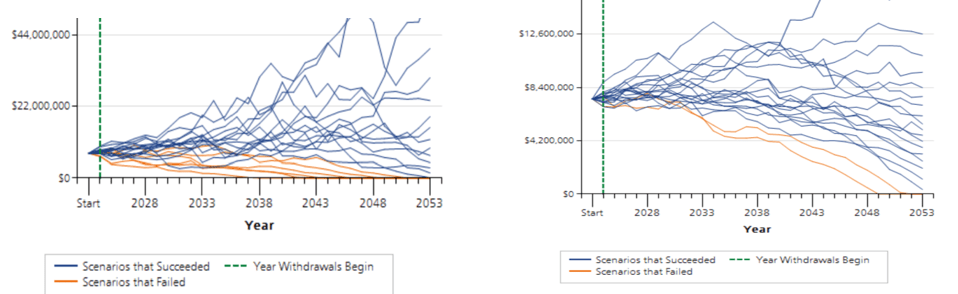
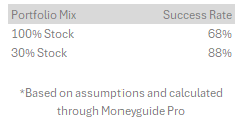
The conclusion is not to say that this investor should be 30% in stock…but rather risk capacity is a meaningful measurement. The appropriate solution should be determined through detailed analysis, and an understanding of the inputs that make or break a portfolio…not just a 10 question survey that tells you your risk tolerance.
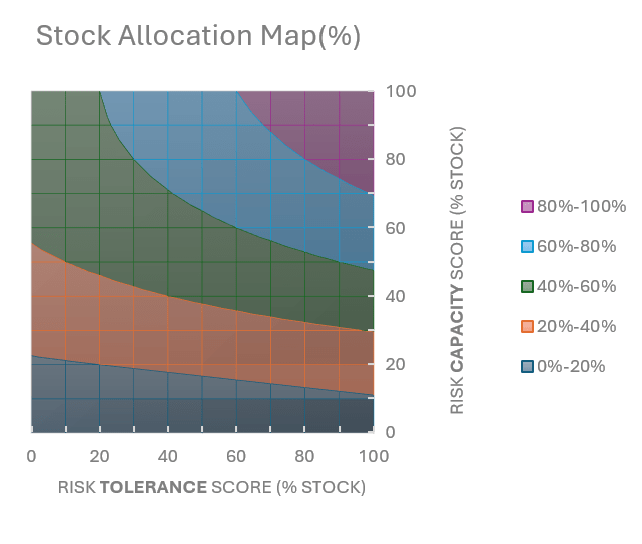
Finally – below is a visual representation of a possible way to join tolerance and capacity. The takeaway here is that capacity might be more important than tolerance. In other words, an 80% risk tolerance means next to nothing if your capacity is only 20%.
Disclaimer
All calculations within are performed from scratch and, while diligent efforts are made to ensure accuracy, may contain unaudited errors. The content provided is for informational purposes only and should not be construed as investment advice, an offer, or a solicitation to buy or sell any financial instruments. Readers should consult with a qualified financial advisor for personalized advice tailored to their individual circumstances. All investments are subject to a risk of loss. Diversification and strategic asset allocation do not assure profit or protect against loss in declining markets. These materials do not take into consideration your personal circumstances, financial or otherwise.
 Wealth Studio
Leave a comment